

AI
Self-service test data
Agile development

A recent CIO article i've read made a compelling case for reopening the classic build-versus-buy question. The old default:'buy unless you absolutely have to build', is losing its grip. It raised an obvious follow-up for anyone working in software quality:
What does this mean for test data management?
The honest answer is that building your own TDM tooling is not a bad choice. But the reasoning behind that answer matters more than the answer itself.
How TDM tooling is usually born
It rarely starts with a strategy. It starts with a problem.
A tester needs a specific record. A developer wants to reset an environment. Someone has to mask sensitive columns before data leaves production. So someone writes a script. Someone else improves it. Another team copies it. A Confluence page appears.
Before long, the organization has something that resembles a TDM solution. Sort of.
When scope is small, data is well understood, and risk is low, a lightweight internal tool can outperform a commercial platform on speed and cost. AI makes that case stronger, testers and engineers can now build and iterate faster than ever.
The danger arrives when a local solution quietly becomes an enterprise dependency.
TDM looks simple (until it has to scale)
From a distance, test data management sounds straightforward: take production-like data, make it safe, make it smaller, put it where testers need it.
In practice, it touches privacy compliance, referential integrity, audit trails, access controls, CI/CD pipelines, legacy systems, and environments that were supposed to be temporary but have been running since 2014.
The question shifts from can we build something that works? to can we build something that keeps working: across teams, technologies, audits, and reorganizations?
That is a fundamentally different challenge.
The problems surface through a familiar phrase: "Can we also use it for...?" Each extension adds complexity. The cost that looked low in version one looks very different by version ten, or by the version where nobody knows why a script drops a specific table, but everyone agrees not to touch it.
Enterprise TDM requires product thinking: ownership, documentation, monitoring, security, and support. Most internal tools are not resourced that way. The script that started as a convenience becomes a critical platform. No one budgeted for a platform team.
Privacy changes the calculation
The strongest argument against casual self-build is privacy.
Masking data is easy to underestimate. Replacing a name with a random string is not sufficient. Effective masking must preserve data utility while reducing re-identification risk, consistently, across every execution, respecting relationships and business rules.
Could an enterprise build this capability internally? Technically, yes. But the real question is whether it wants to own everything that comes with it: field discovery, consistent logic, referential integrity, auditability, multi-technology support, and years of ongoing maintenance. At that point, the organization is not maintaining a script. It is running a product.
The most realistic model
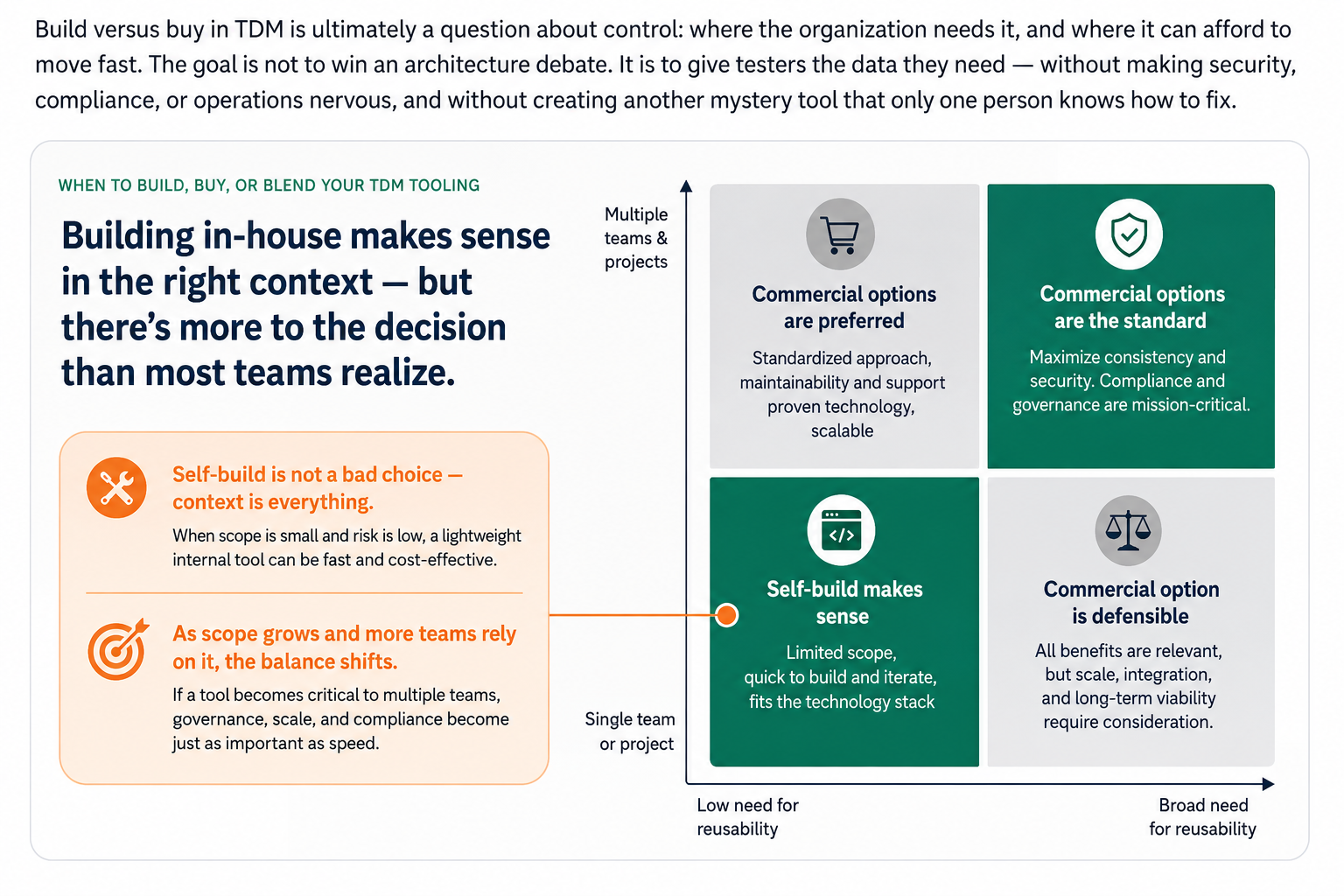
Build: when the problem is local, risk is contained, and the team can sustain what it creates.
Buy: when the problem spans teams, technologies, and compliance boundaries.
Build versus buy in TDM is ultimately a question about control: where the organization needs it, and where it can afford to move fast. The goal is not to win an architecture debate. It is to give testers the data they need, without making security, compliance, or operations nervous, and without creating another mystery tool that only one person knows how to fix.
Do you recognize the buy or build dilemma?
Reach out to the DATPROF team today if you are looking for guidance and advice
Frequently asked questions